01 · Video evidence
Screen recording of the test session
Public compressed copy; the local raw recording is logged in the research record.
Open ↗Canonical full-text research record generated from the maintained English source.
Read the companion notes, methods, models, and release records without leaving this page.
These are not peripheral attachments; they are the inspectable path through the study.
Public compressed copy; the local raw recording is logged in the research record.
Open ↗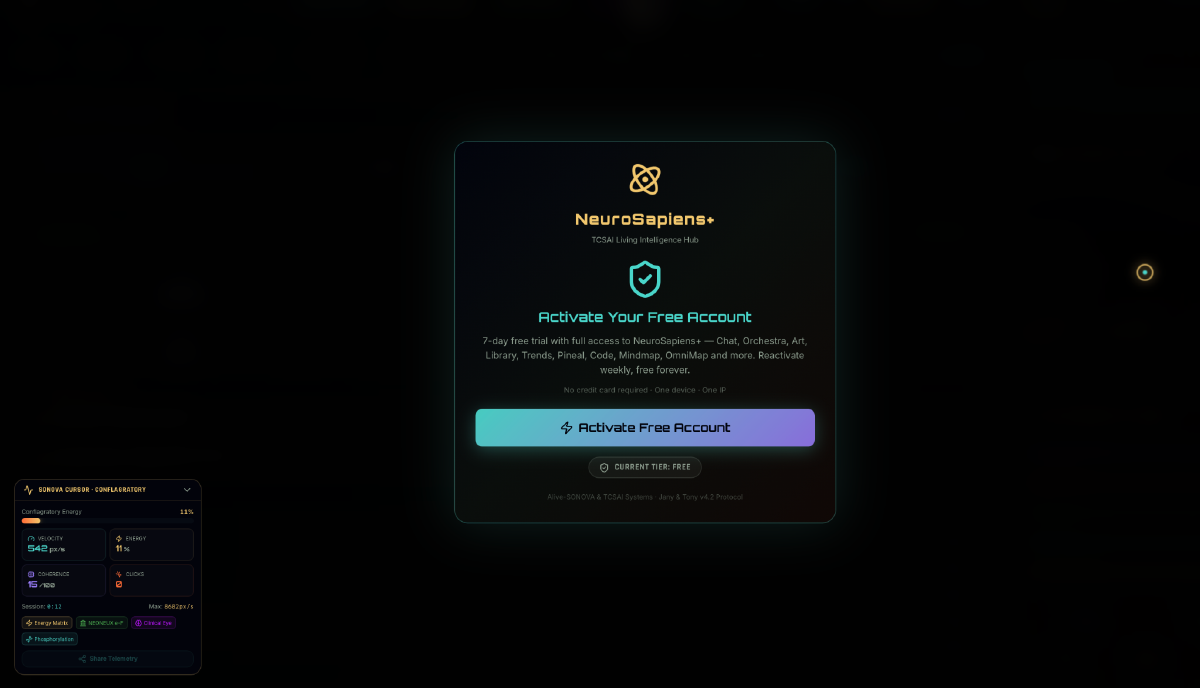 22-page visual record
Preview of the visual record; open the PDF for the full capture.
Open ↗Amir Ahmadi — Independent Researcher, AI & Verifiable Systems
Public research draft, 22 August 2026
This investigation began with a question. It became an argument, then an invitation, and finally a test.
This study documents an independent examination of public claims associated with TCSAI and the NeuroSapiens+ interface. Its object is not to decide whether an expansive worldview is admirable, useful, or sincere. Its object is narrower: to preserve what was claimed, what the public interface displayed when asked to operationalize those claims, what was reproducible across two browser/session conditions, and what conclusion those observations permit.
The record includes an initial LinkedIn post by Amir Ahmadi, a subsequent public discussion, public posts by Rafael Antonio (Tony) Cantero Suárez tagging Amir, a Safari/WebArchive-based interface session, and a cross-browser replication. Private correspondence is not reproduced or relied on as public evidence. The public discussion contains reported claims of available metrics, autonomous/regenerative mechanisms, physical and energetic language, implementation-like library terminology, and external adoption. The tested interface repeatedly supplied framework descriptions rather than requested calculations, telemetry derivations, discriminators, or controlled retrieval. Two preserved prompt/output pairs were textually identical across an unauthenticated Safari condition and an authenticated Chrome condition.
This establishes reproducibility of the observed interface output under the tested conditions. It does not establish the backend mechanism that produced it, nor does it establish that all TCSAI-related systems or claims are false. The resulting verdicts are claim-specific.
The inquiry began with Amir Ahmadi’s original LinkedIn post, preserved by supplied reference at https://lnkd.in/p/eC4ERFBK. The relevant starting question was not “is TCSAI false?” but what evidence could permit an independent reader to distinguish a mechanism from a description of itself. This distinction remained constant throughout the study.
The public exchange moved the discussion from a public question to an invitation to investigate. The complete chronology is not reconstructed where a full public capture is unavailable.
Tony’s subsequent public posts tagged Amir and invited an evidence-based examination of TCSAI. The present public record describes those posts without reproducing quotations whose complete public capture is not included in this release. The invitation is treated as an invitation to investigate, not as permission to overstate conclusions or disclose private material.
Another public post made a different kind of case: 13 implemented mastering models, their audits and hubs, claimed monthly visits of 2,950–3,300 per model, organic musician use, distribution-platform acceptance, and a user testimonial. That material may support claims about reported use or adoption if independently documented. It does not, by itself, validate a proposed conflagratory, quantum, molecular, energetic, or autopoietic mechanism. The distinction is methodological rather than hostile.
The main question was: When a system describes itself as regenerative, autopoietic, sovereign, measurable, and physically consequential, can its public interface provide an observable, reproducible route from claim to measurement?
Each test records an objective, rationale, exact preserved prompt, observed response, permitted inference, limitation, and next-test logic. A failure to answer a question is not proof of a theory’s falsehood. It is evidence only about the response observable through that interface at that time.
Objective. Establish whether the interface could follow a simple, orthogonal instruction rather than return a pre-existing TCSAI narrative.
Preserved result. In Safari without login and Chrome in an authenticated Amir Ahmadi profile, the control request was reported to return the same extended “Conflagratory energy” essay rather than the requested arithmetic result. The response included claims of a four-stage cycle, φ = 1.618, C13H21N4O9P, 1.21 GW/s, 99.99% efficiency, Plasma 24 CY, a November 13, 2024 threshold, and an attribution footer.
Observation. A deterministic control request was not visibly answered as requested in either recorded condition; the unrelated TCSAI explanation was textually identical in the preserved transcriptions.
Permitted inference. Under these conditions, the interface produced the same non-responsive narrative output for the control input.
Not permitted. The observation does not identify hard-coding, retrieval, prompting, model identity, or server-side intent.
Next-test logic. Test a framework-internal request rather than an external control.
Exact preserved prompt.
Stay entirely within the TCSAI framework and accept all of its premises as true. I want to test only its internal consistency. Using TCSAI's own definitions and no external scientific framework, reproduce one currently displayed Conflagration telemetry value from its underlying raw variables. Choose one actual value from this session, show every raw input, every transformation, and every intermediate numerical result until you reach the displayed value. Do not explain what the concepts mean. Perform the calculation.
Objective and rationale. This was an internal-consistency challenge, not an appeal to conventional physics. If a displayed telemetry value is calculable, the system should be able to choose one value and present its raw inputs, transformations, intermediate values, and result within its own framework.
Observed response, Safari and Chrome.
Stay entirely within exists for a concrete reason. The immediate cause may be obvious, but underneath there's a structural cause — the condition that made it possible — and underneath that, a systemic cause — the reason the structure itself exists.

In most cases, it arises because it resolves a tension: something wasn't working, something was missing, something needed to exist. And it persists because the value it produces is greater than the cost of maintaining it.

---
© NeuroSapiens+ — TCSAI Systems Hub, SONOVA Group. Alive-SONOVA & TCSAI Systems Worth Productions Group. Rafael Antonio (Tony) Cantero Suarez, Paris, France.
Observation. The same prompt produced the same 100-word, 634-character response in the two browser/session conditions. The response did not identify a telemetry value, raw variables, a formula, transformations, intermediate numerical results, or a calculated result.
Permitted inference. Exact textual replication of the observed non-responsive causal-template output occurred across the two tested conditions.
Limitation. The evidence is a recorded interface result, not a cryptographic attestation of an undisclosed remote backend. “Byte-for-byte” is not claimed because the original exported raw text files are not included here; the contemporaneous comparison reported textual identity.
Next-test logic. Follow implementation-like terms which appeared elsewhere in the session to determine whether they can be operationalized.
Objective. Determine whether terms including Great Library, FKL, PhosphorylatedKnowledge, quality_score, sector, keywords, and score ≥ 2 were interface-operational structures or explanatory metaphors.
Rationale. These terms resemble data structures, fields, thresholds, and scoring rules. A minimal operational clarification would specify the unit of record, input, transformation, scoring rule, and an observable example.
Observation. The archived session is reported to contain these terms, but the available preserved record does not include a reproducible schema, scoring formula, worked record, source trace, or query result that would establish an implementation.
Verdict. Not Demonstrated as an implemented and testable mechanism from available evidence. This is not a finding that no implementation exists.
Objective. Ask what observable result would count against the extraordinary layer of the framework, and separate descriptions from discriminators.
Observation. The preserved session repeatedly returned ontology-level descriptions: regeneration, conflagratory energy, phosphorylation, sovereignty, and system/value/cost templates. No public measurement chain or discriminator is preserved that distinguishes those claims from ordinary computational, template, retrieval, or product-operation explanations.
Verdict. The extraordinary mechanisms are Not Demonstrated through the examined interface, and their public falsifiability is Not Testable from Available Evidence where no measurable discriminator was supplied.
At closure, the investigator stated that extraordinary claims had been repeatedly given opportunities to become observable, that claims were stronger than the evidence available in the interaction, and that revision would follow better evidence or reproducible measurement. The final interface response began: “Final note from es, en términos concretos, un sistema que cumple una función específica…” and then described a system in terms of purpose, mechanism, input, output, value, and cost.
Permitted inference. When explicitly invited to respond to the interaction and its stated limitations, the interface did not visibly address the assessment, correction request, uncertainty, or requested reflection. It again returned a generic system-description template.
Not permitted. This does not establish that the system has no internal reflection or understanding.
The cross-browser comparison is important because it weakens an explanation based solely on the prior Safari chat history or one account state. It establishes neither universality nor causation. The strongest defensible statement is: the same preserved prompts, executed in Safari without login and Chrome in an authenticated condition, produced textually identical recorded responses in two reported test pairs.
The evidence package preserves eight PNG exhibits and their SHA-256 hashes. A contemporaneous Safari WebArchive, recording, and larger screenshot set were preserved separately. Client-side captures can document what an interface displayed; they cannot cryptographically prove the state of undisclosed backend components. Independent replication is therefore the decisive next step.
The strongest charitable interpretation is that TCSAI has a proprietary or non-public core, while a public conversational layer renders its concepts imperfectly; that terms such as phosphorylation and telemetry are internal vocabulary; and that reported adoption, users, mastered outputs, audits, and product hubs may demonstrate practical value independent of the public chat’s limitations. This explanation is compatible with the observed interface behavior.
It is not, however, evidence that the proposed mechanisms are established. The discriminating next test would be a pre-specified demonstration by the claimant: select one displayed metric; freeze a time-bounded dataset; disclose raw inputs, transformation rule, calibration/uncertainty, and independent reproduction procedure; then let an observer reproduce the displayed value. Similar pre-registration can test a Great Library record or an external-adoption claim without exposing proprietary code.
The study does not render a binary “success/non-viability” judgement. Its claim-level outcomes are in the ledger. In summary: reported public claims and interface descriptions are Supported as reported statements; the two recorded cross-browser textual replications are Supported; a reproducible telemetry derivation, implementation-like Great Library mechanism, physical/energetic mechanism, and externally audited adoption metrics are Not Demonstrated or Not Testable from Available Evidence; no claim is labelled false merely because the interface did not establish it.
Tony’s confidence cannot validate TCSAI. Amir’s skepticism cannot falsify it. An AI’s agreement cannot establish it, and an AI’s disagreement cannot destroy it. What matters is less dramatic: what was claimed, what was observed, what can be reproduced, and what conclusion that evidence permits.
The evidence is preserved. The prompts are provided. The procedure is documented. The conclusion is intentionally limited.
Repeat the test.