Before I Knew What to Measure
Following an Intuition Through Behavioral Data, Space Weather, and the Search for What Actually Changed
Author: Amir Ahmadi
Release: v0.1
Date: 31 August 2026
Type: Evidence-backed personal investigation / working research essay
This paper does not claim that space weather caused the symptoms described below. It documents how an intuition generated a hypothesis, how behavioral and environmental records were assembled after the fact, and how the first controls weakened the simplest causal explanation.
For almost a week, I stopped feeling like myself.
Not emotionally. Not philosophically. Physically and cognitively.
My energy dropped sharply. My muscles felt weak. Concentration became difficult. I could no longer sustain the kind of research and deep work that normally occupies much of my waking time. I stopped going to the gym because I did not feel that I had enough energy to train.
Then there was the sleep. I was unusually sleepy and could sleep for long periods without feeling restored.
The daily pattern was strange. Around three or four in the morning I could sometimes feel almost normal again: I could read, think, investigate and write. By roughly nine in the morning, energy and concentration tended to fall sharply. Sleep became attractive again. Sometimes I slept into the afternoon or evening, and after midnight the cycle seemed to reset.
After several days, a question appeared before I had any data-driven reason to ask it:
What if something outside me had changed?
For reasons I could not explain at the time, my mind went to the Sun.
So I checked.
And, unfortunately for my objectivity, something real was happening.
The moment intuition becomes dangerous
I had not been following space-weather reports. I did not know beforehand what had happened on the Sun that week.
When I looked, I found that SIDC reported five M-class flares in the 24 hours preceding its August 25 bulletin. The largest was an M6.9 flare peaking at 10:02 UTC from NOAA Active Region 4513. The same bulletin noted associated coronal dimming and said that any corresponding CME still required analysis. Importantly, its geomagnetic classification at the time of issue was still quiet. [1]
This distinction matters because a solar flare, a CME, a forecast watch and an observed geomagnetic storm are not interchangeable events.
The discovery nevertheless produced an immediate human reaction:
Maybe I found it.
That was the point at which the intuition became dangerous.
There were now two real observations:
- Something unusual had been happening to me.
- Something measurable had been happening in the solar and near-Earth environment.
Everything connecting those facts was still missing.
Coincidence is not causality.
So instead of asking how I could prove the intuition correct, I changed the problem: how quickly could I make it fail?
I had accidentally been collecting data
I did not have continuous physiological measurements. I had no laboratory-grade sleep record, EEG, cortisol series or contemporaneous bloodwork capable of explaining the episode.
But my devices had been recording part of my behavior before the hypothesis existed.
Apple Screen Time on the Mac and iPhone contained daily activity totals, application categories and timing patterns. These data are not measures of fatigue, cognition or muscular strength. Screen Time is not a biomarker.
But it can leave a behavioral trace.
And because much of the record existed before I thought about solar activity, it offered something retrospective memory could not: a partially independent record of what I had actually been doing.
The first lesson came quickly. I had been looking at the wrong variable.
Twelve hours online can mean two different things
If fatigue were the problem, total Screen Time might seem like the obvious proxy. The data immediately complicated that assumption.
On August 29, my iPhone Screen Time was about 4 hours 13 minutes. On August 30, it was about 12 hours 54 minutes.
At first glance, that looks inconsistent with a depleted state. But on August 30, approximately 11 hours 24 minutes were categorized as Social plus Entertainment, about 88% of the day's total.
Earlier in the month, August 10 produced an even higher total: about 16 hours 20 minutes. Yet roughly 9 hours 25 minutes were categorized as Productivity & Finance.
High Screen Time existed in both states. The composition was radically different.
When cognitively engaged, long device use can represent research, writing, analysis, building or sustained problem-solving. When depleted, digital activity can also mean lying down, scrolling, moving between social feeds, checking markets, opening material without sustaining attention, or repeatedly starting and abandoning tasks.
That produced a more useful observation:
The interesting signal was not how much I used my devices. It was what my mind appeared capable of doing while I was awake.
Total Screen Time was a poor proxy for cognitive state. Composition, timing and persistence appeared more informative.
The Mac record suggested reduced persistence, not complete incapacity
The Mac data added another layer.
Across August 15–22, recorded Mac use averaged roughly 9 hours 29 minutes per day. Across August 23–30, it averaged about 5 hours 27 minutes per day—a decline of approximately 43%.
Yet the category labelled Productivity & Finance changed far less: from roughly 3 hours 46 minutes per day to approximately 3 hours 31 minutes, only about a 7% decline.
Those categories are coarse, and they should not be interpreted as direct measures of deep work. Still, the asymmetry is interesting.
The behavioral change was not simply "I could no longer work." Productive windows still existed. What appeared to change more strongly was my ability to remain active for long periods.
A better description may be:
I could still enter a productive state, but I could no longer reliably remain there.
That suggested a variable I had not originally considered: cognitive persistence.
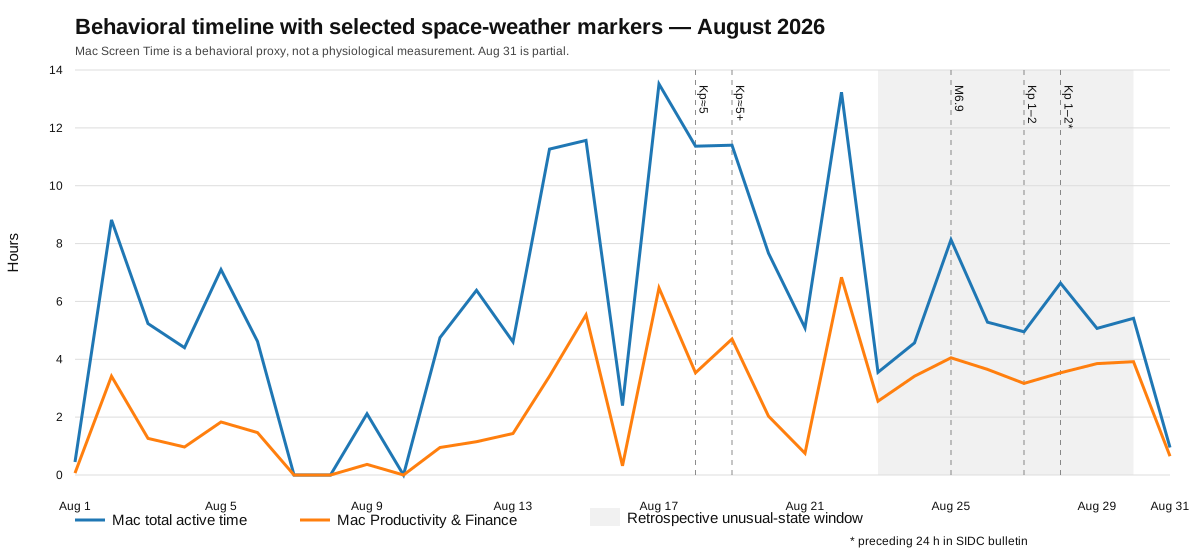
Figure 1. Daily Mac Screen Time and Productivity & Finance minutes across August 2026, shown with selected audited space-weather markers. The figure is descriptive, not a causal analysis. August 31 is a partial day. Zero-use days may represent true non-use or incomplete Screen Time capture.
Then the first control attacked the solar hypothesis
A simple causal hypothesis should survive simple counterexamples.
If greater geomagnetic disturbance were responsible for the deterioration, then periods of comparable or stronger geomagnetic activity should tend to coincide with similar behavioral deterioration.
I looked backward and found the opposite.
SIDC reported NOAA Kp 5+ between 18:00 and 21:00 UTC on August 18 and Kp 5 again between 03:00 and 06:00 UTC on August 19. The same bulletin reported IMF Bz varying between approximately -10 nT and +12 nT during the preceding 24 hours. [2]
Yet my Mac Screen Time record was approximately:
August 18: 11h 22m
August 19: 11h 24m
Those days did not resemble the late-August behavioral state I was trying to explain.
This was the first useful counterexample.
The simple hypothesis
higher geomagnetic activity → lower functioning
was already in trouble.
The timing introduced another problem. On August 27, SIDC described the preceding 24 hours as globally quiet, with NOAA Kp 1–2, while later enhancement remained a forecast. [3] The August 28 bulletin likewise distinguished observed conditions from possible later enhancement. [4]
If the behavioral anomaly had already begun before the more notable near-Earth disturbance, then the narrative could not simply place the cause wherever it was convenient.
A cause cannot arrive after its effect merely because the story is attractive.
The first thing the data did was disappoint my intuition.
That was useful.
A real event is not necessarily a real connection
My intuition led me toward something that existed. There really was significant solar activity. There really were changing solar-wind and geomagnetic conditions during the broader period.
But:
Evidence that an environmental event occurred is not evidence that it affected me.
The mind can cross that gap almost invisibly:
I felt something → I suspected X → I checked X → X was happening → therefore X caused what I felt.
The final arrow is the dangerous one.
This project preserves the difference between observation and explanation by keeping forecast and observed conditions separate, retaining counterexamples, and treating planetary Kp as a planetary index rather than a local measurement of exposure at my location.
Trying to kill the hypothesis
The correct question was no longer "What evidence supports the intuition?"
It became:
What should I observe if the intuition is wrong?
That leads to harder tests. Are there geomagnetically active days with normal behavior? Are there quiet days with poor behavior? Does a stronger event fail to produce the state? Is there any repeatable dose-response relationship?
There is also a methodological trap. If Kp fails, I can try Bz. If Bz fails, I can try solar-wind density, then speed, then Dst, then different lag windows. With enough variables and enough temporal flexibility, something will eventually look interesting.
That can be discovery—or it can be confirmation hunting.
For that reason, the next phase predefines environmental variables as Kp, Dst, IMF Bz, solar-wind speed and solar-wind density, with fixed lag windows of 0, 6, 12 and 24 hours. Those choices are documented before prospective comparison.
The objective is not to find a correlation. It is to make the hypothesis easy to falsify.
The competing physiological question remains open
The symptoms described here—fatigue, excessive sleepiness, muscular weakness, reduced exercise capacity and concentration difficulty—are nonspecific.
Many ordinary physiological states could generate the same pattern. The current project has no synchronized physiological measurements capable of distinguishing among them.
That means the personal health question and the research question must remain separate.
The absence of a physiological explanation does not increase the probability of an unusual environmental explanation merely because the latter is interesting.
This distinction is especially important because the scientific literature on geomagnetic activity and human health is not empty, but it is also not strong enough to convert a personal temporal coincidence into a causal inference.
A 2017 review discussed reported biological correlations, simulated geomagnetic-storm experiments and possible mechanisms including circadian pathways, cryptochrome and melatonin. [5] A 2026 systematic literature review describes a long-running field with substantial methodological and data gaps. [6] A 2026 GeoHealth review reports neurological and neuropsychiatric associations in observational literature while explicitly characterizing current evidence as largely associative and calling for stronger longitudinal and mechanistic work. [7]
Those papers justify asking careful questions. They do not justify claiming that this episode was caused by space weather.
Maybe intuition was solving a different problem
At this point, the investigation became more interesting than the original solar hypothesis.
What if intuition was not identifying a cause at all?
What if it was performing a more primitive operation: anomaly detection?
A biological system receives countless inputs that never become explicit conscious propositions—sleep pressure, light, temperature, internal bodily state, routine, stress, sound, environmental rhythm and other weak signals.
It is at least conceptually possible for a system to register:
something is different
without correctly identifying:
this is why.
That distinction became the central thesis of the project:
Anomaly Detection ≠ Causal Identification
Perhaps intuition can be useful at the first task while being unreliable at the second.
My intuition generated a search direction. That search found a real event. The discovery made a causal narrative tempting. The controls then forced the narrative back open.
The sequence became:
Experience → intuition → hypothesis → external search → discovery → attempted falsification → uncertainty
Uncertainty is not failure. It is the point at which measurement begins to replace narrative.
What the first control taught me
One sentence captures the turning point:
My intuition survived the discovery. It did not survive the first control.
But that does not mean the intuition had no value.
It changed the question from "Was I right about the Sun?" to "What exactly is intuition good for?"
Maybe intuition should not be treated as evidence. Maybe it is better understood as a hypothesis generator: something that flags a discrepancy, directs attention and reduces a large search space into a question that can then be tested.
After that, its job should end.
Measurement must take over.
The next experiment
The current evidence is retrospective, incomplete and behaviorally indirect. It cannot answer the causal question.
A better phase would be prospective and partially blinded. Daily subjective measures would be recorded without looking at space-weather conditions: energy, concentration, sleep timing, perceived muscular strength, exercise capacity and ability to sustain deep work. Device behavior could remain an independent secondary trace.
Only after those observations are locked would they be compared with the predefined environmental variables and lag windows.
Quiet periods must remain in the dataset. Strong events with normal behavior must remain in the dataset. Poor-behavior days during quiet conditions must remain in the dataset.
If nothing survives, that is a result.
If a weak association survives, it is a signal—not a conclusion.
If the same relationship repeats prospectively across independent events, only then does the question become substantially more interesting.
A second research question emerged from the failure
Even if the space-weather hypothesis disappears completely, the device record points toward another potentially useful idea.
Digital behavior may contain traces of cognitive state that total Screen Time hides.
Six hours of focused research and six hours of fragmented scrolling both appear as six hours on a dashboard, but they represent very different behavioral states.
A more informative model may need to consider:
duration + composition + fragmentation + timing + persistence
rather than hours online alone.
In this dataset, the transition from sustained Mac activity toward shorter active windows and, on some days, heavier passive iPhone use may be more interesting than the environmental hypothesis itself.
So, did I feel a solar storm?
I do not know.
Based on the evidence in this release, I cannot responsibly say that I did.
Some evidence actively weakens the simplest version of that explanation: geomagnetically active control periods with relatively strong behavior, imperfect timing, no demonstrated dose-response relationship, no local exposure measurement, no physiological measurements and multiple competing explanations.
The result is therefore not a causal claim.
It is a record of what happened when an intuition was treated as the beginning of inquiry rather than the end of it.
I began with a strange bodily experience. My intuition pointed toward the Sun. The Sun happened to be active. For a moment, that felt like an answer.
Then the data turned the answer back into a question.
That may be the more useful outcome.
Before I knew what to measure
We often treat intuition as one of two things: hidden wisdom that somehow knows before reason does, or unreliable noise that rational analysis should ignore.
I suspect that distinction is too simple.
Maybe intuition sometimes performs a different function. Maybe it notices a discrepancy before conscious reasoning has constructed the correct model for it.
Maybe it does not say:
This is true.
Maybe it says:
Something here deserves attention.
That would make intuition neither evidence nor magic.
It would make it a signal generator—a mechanism for deciding where measurement might begin.
I still do not know what caused the episode described here. I do not know whether any environmental association will survive a better experiment. It may disappear completely, and a strong experiment must be allowed to make that happen.
The question I am left with is therefore larger than the answer I originally wanted:
What does the body notice before the conscious mind knows what to look for?
And perhaps the lesson is simpler:
Maybe intuition is not a way of knowing.
Maybe it is a way of noticing where knowing should begin.
References
[1] SIDC, Daily bulletin on solar and geomagnetic activity — 25 Aug 2026. https://www.spaceweatherlive.com/en/archive/2026/08/25/sidc-ursigram.html
[2] SIDC, Daily bulletin on solar and geomagnetic activity — 19 Aug 2026. https://www.spaceweatherlive.com/en/archive/2026/08/19/sidc-ursigram.html
[3] SIDC, Daily bulletin on solar and geomagnetic activity — 27 Aug 2026. https://www.spaceweatherlive.com/en/archive/2026/08/27/sidc-ursigram.html
[4] SIDC, Daily bulletin on solar and geomagnetic activity — 28 Aug 2026. https://www.spaceweatherlive.com/en/archive/2026/08/28/sidc-ursigram.html
[5] Krylov, V. V. (2017). Biological effects related to geomagnetic activity and possible mechanisms. Bioelectromagnetics, 38(7), 497–510. https://doi.org/10.1002/bem.22062
[6] Arnaut, F., Kolarski, A., & Jevremović, S. (2026). Solar activity, space weather and human health: can ChatGPT assist systematic literature reviews? International Journal of Biometeorology, 70(5), 143. https://doi.org/10.1007/s00484-026-03220-6
[7] Sethi, Y. et al. (2026). Aurora-Associated Geomagnetic Activity and Health: A Review With Focus on Neurological Implications. GeoHealth, 10(6), e2025GH001710. https://doi.org/10.1029/2025GH001710
Data and audit trail
Behavioral data, evidence manifests, methods and figure source files are maintained in the parent project directory. This release should be read together with ../../methods/analysis-plan.md, ../../data/, ../../evidence/, ../../references/audit-sources-v0.1.md, and the source figure in ../../figures/.